
Partenaires
Comité Scientifique
- Badreddine Rabia
Ineris - Barthès Amélie
SGS - Bas Azilis
Institut de la Transition Foncière - Bossert Frédéric
Züblin Umwelttechnik - Carpentier Antoine
Fidal - Counet Lionel
Injectis - De La Hougue Christel
UPDS - Devic-Bassaget Boris
SARPI Remediation France - Eisenlohr Laurent
Cerema - Epardeau Patrick
Brézillon - Foucart François
Baudelet Environnement - Garnier Romain
Cluster Eau-Milieux-Sols - Godain Alexiane
Tauw - Goulian Erwan
Evonik - Grand Cécile
Ademe - Gris Alexis
Apave - Hanot Cédric
2TER - Heissat Etienne
Archimed Environnement - Janus Adeline
Energipole - Joubert Antoine
Actierra - Karg Frank
HPC International - Lallahem Sami
Ixsane - Laurette Julien
JL Conseil - Lemal Laure
Ginger Burgeap - Limousin Vincent
Webs - Machinet Gaylord
Microhumus - Malandain Cédric
Estralab-Enoveo - Martelain Jacques
Terraquatron - GESDEC - Michel Julien
Ineris - Mourard Sylvain
Mérieux NutriSciences - Nsonda Christian
Axelera - Oudin Philippe
Semaco Environnement / Mines de Nancy - Pacaud Olivier
Brézillon - Pauget Benjamin
Tesora - Pommier Thomas
Setec Energie Environnement - Regnier Rodolphe
Colas Environnement - Rollin Hugues
Helios Avocats - Sénéchaud Jonathan
Colas Environnement - Soussou Souhir
Fertil'Innov - Thannberger Laurent
Elteach Conseil - Uomobono Rose
Léonard - Vague Maurice
MVCS Conseil - Vergnerie Marie-Léonie
Fieldfisher
Résumé
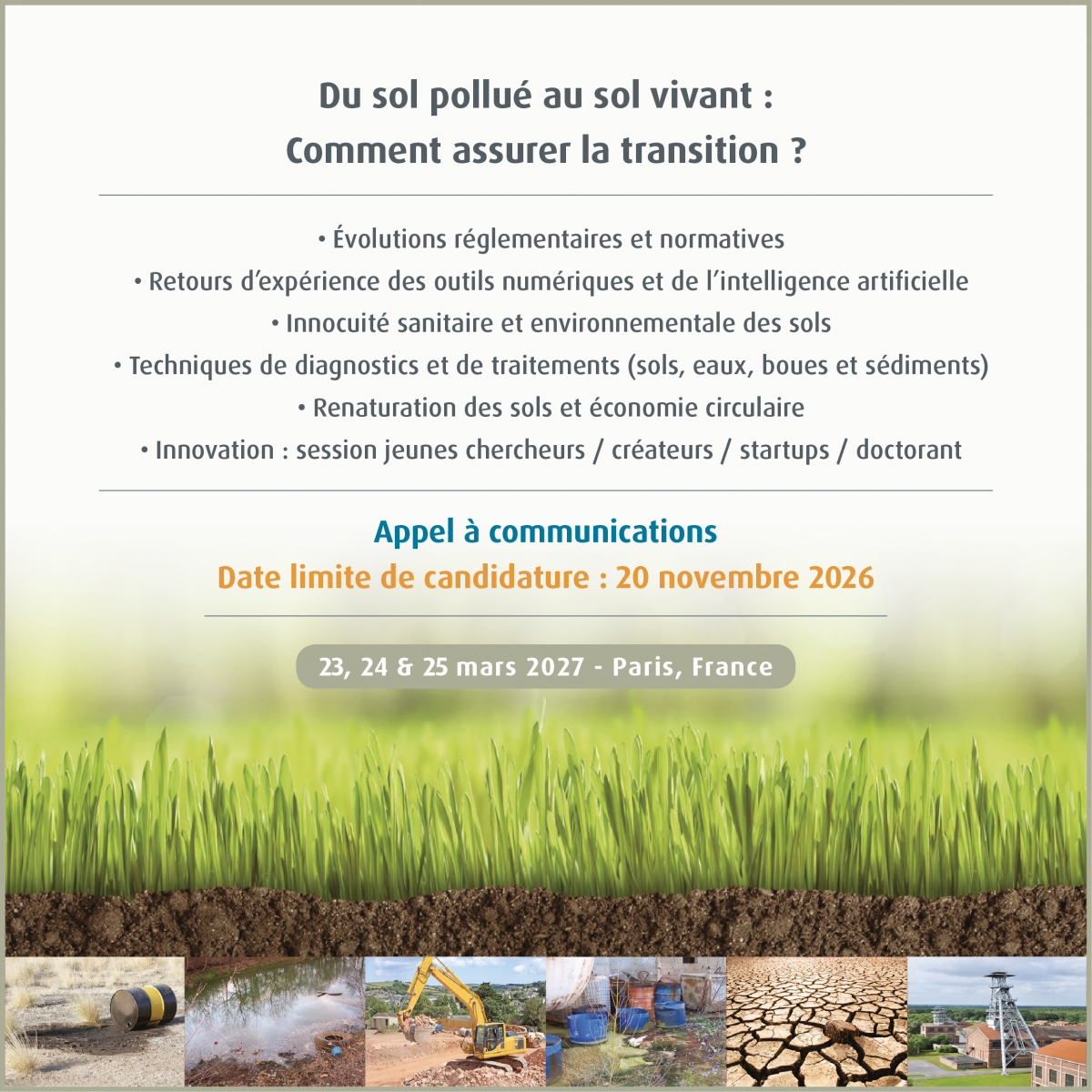
Du sol pollué au sol vivant :
comment assurer la transition ?
Du 23 au 25 mars 2027, la 26ᵉ édition du
Congrès INTERSOL réunira à Paris l'ensemble des acteurs de la
filière des sites et sols pollués pour le plus grand rendez-vous national consacré aux sols.
Dans un contexte marqué par l'évolution des réglementations, les avancées technologiques et les enjeux de transition écologique, INTERSOL s'impose comme le lieu incontournable pour partager les connaissances, confronter les expériences et faire émerger les solutions de demain.
Cette édition s'articulera autour de la thématique générale Du sol pollué au sol vivant : comment assurer la transition ? déclinée en six grandes sessions :
- Évolutions réglementaires et normatives
- Retours d'expérience des outils numériques et de l'intelligence artificielle
- Innocuité sanitaire et environnementale des sols
- Techniques de diagnostics et de traitements (sols, eaux, boues et sédiments)
- Renaturation des sols et économie circulaire
- Innovation : session jeunes chercheurs / créateurs / startups /doctorant
Une table ronde conçue et animée par le Cluster Eau Milieux Sols, Axelera et l'Institut de la Transition Foncière viendra également enrichir les échanges autour des grands enjeux actuels et futurs de la filière.
Pendant trois jours, INTERSOL offrira une opportunité unique de rencontrer les experts, maîtres d'ouvrage, bureaux d'études, entreprises, industriels, chercheurs, institutionnels et décideurs qui façonnent les évolutions du secteur. Conférences, retours d'expérience, débats et temps d'échanges permettront à chacun de développer son réseau, de partager ses pratiques et de découvrir les innovations qui feront les références de demain.
Thèmes
▬ 6 grands thèmes ▬
1 - Evolutions réglementaires et
normatives
Mots-clés :
Réglementation / Directive cadre / Normalisation / Transposition /
Jurisprudence / Financement / Fond vert / Droit de l’environnement
2 - Retours d’expérience des outils numériques et IA
Mots-clés : Opportunités,
risques et enjeux de l’IA / Adaptation de la profession / Accessibilité et
gestion de la donnée / API et services / impact environnemental
3 - Innocuité sanitaire et environnementale des sols
Mots-clés : Risques sanitaires et environnementaux / Dangerosité /
Modélisation / Mesures / Surveillance environnementale / Gestion durable des
sols
4 - Techniques de diagnostics et de traitements
(sols, eaux, boues, sédiments)
Mots-clés :
Solutions innovantes / Sobriété et économies d’énergie / Impacts carbone /
Solutions Fondées sur la Nature / Polluants d’intérêt émergents / Amiante /
Diagnostic environnemental et agropédologique / écotoxicologie / techniques
combinées ou arbitrage / Santé des sols / Valeurs de référence
5 - Renaturation des sols et économie circulaire
Mots-clés :
Solutions Fondées sur la Nature / Valorisation des TEX / Technosols / Terres
fertiles / Espèces exotiques envahissantes / Agropédologie / Fonctions des sols
et Services écosystémiques / refonctionnalisation des sols / approche
holistique / Biodiversité
6 – Innovation : session jeunes chercheurs / créateurs / startups
/doctorant
Les travaux présentés sous la forme de
pitches, devront être en lien avec les 5 thèmes du colloque
Les interventions à deux voix, réunissant maîtres d’ouvrage et maîtres d’œuvre, seront privilégiées.
Si vous souhaitez partager votre témoignage lors d'une table ronde, merci de nous le préciser.
Date limite de candidature : 20 novembre 2026
Important !
Les contributions seront sélectionnées en fonction :
✧ de leur capacité à présenter des retours d'expérience sur un ou plusieurs cas d'usages
✧ de la mise en avant de leur nouveauté ou de leur amélioration par rapport aux connaissances existantes
✧ de la mise en contexte technique, économique, énergétique, environnementale et sociale
✧ des perspectives envisagées et de leur justification
✧ de leur capacité à présenter des retours d'expérience sur un ou plusieurs cas d'usages
✧ de la mise en avant de leur nouveauté ou de leur amélioration par rapport aux connaissances existantes
✧ de la mise en contexte technique, économique, énergétique, environnementale et sociale
✧ des perspectives envisagées et de leur justification
Pour être prise en compte, toute candidature devra obligatoirement être accompagnée :
- De l'intitulé de l'exposé en français et en anglais
- D'un résumé en français ou en anglais