
Partners
Samenvatting
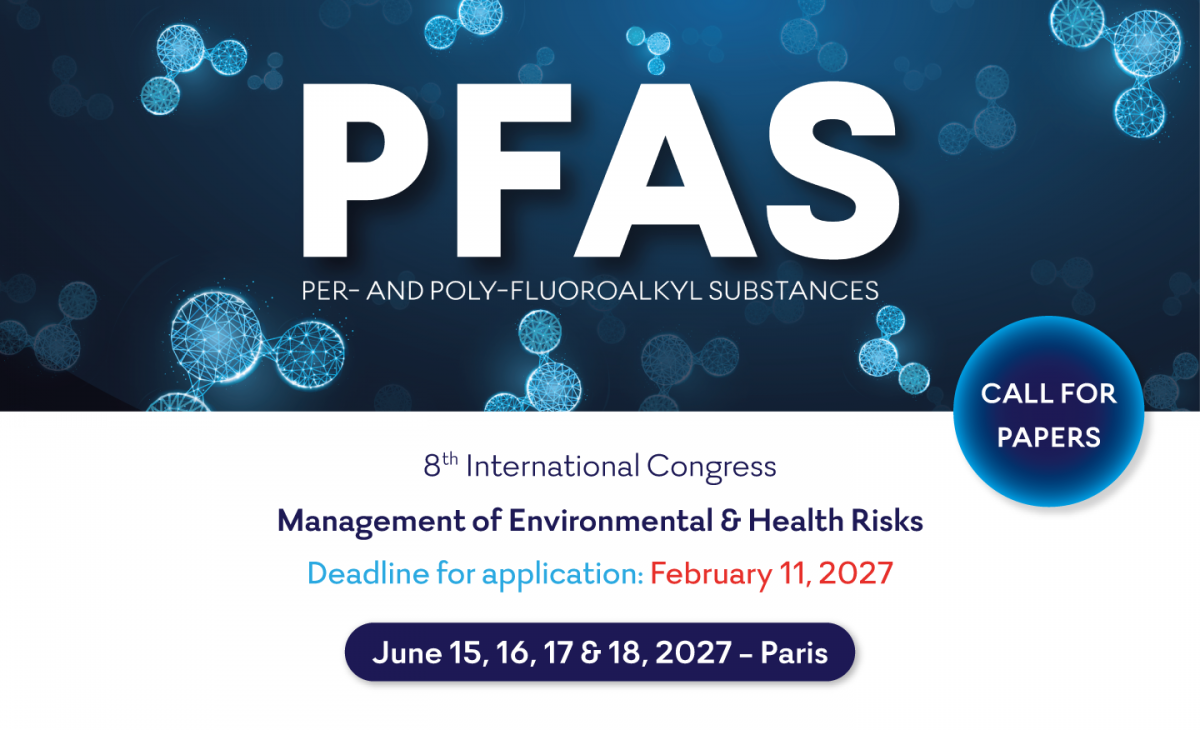
8th International PFAS Congress
PFAS: “Forever Chemicals” — A Major Challenge for the Environment and Public Health
Per- and polyfluoroalkyl substances (PFAS) are increasingly recognized for their significant impact on the environment and public health.
Thousands of products containing PFAS have contributed to the contamination of thousands of sites over the past 60 years. These substances, comprising more than 9,000 compounds, are characterized by their exceptional stability and their ability to bioaccumulate.
Their toxicological effects may include endocrine disruption, hepatotoxic effects, and carcinogenic effects. Due to their extreme persistence in the environment, PFAS are commonly referred to as “forever chemicals.”
An International and Multidisciplinary Challenge
Strategies for managing the environmental and public health challenges associated with PFAS will be presented and discussed, particularly in relation to the international regulatory context and legal requirements.
The topics addressed will include:
- Contaminated-site investigations and environmental chemistry;
- Environmental and human health risk assessments;
- Toxicology and epidemiology;
- Management and site remediation plans, as well as cleanup objectives;
- Treatment technologies for water, soil, and air;
- Research & development in the field of PFAS.
From June 15 to 18, 2027, in Paris, the 8th International PFAS Congress will provide a unique opportunity to meet and exchange with all stakeholders involved in this major environmental and public health challenge.
We are interested in your experience and feedback!
Submission deadline: February 11, 2027
Dr. Frank P. M. Karg (PhD)
Atlantis Développement, SFSE, ARET, ABE
Thema's
▬ 7 major themes ▬
1. International Legal Context
- International regulatory frameworks and developments
- Standards, guidelines and reference values for PFAS
- Emerging regulatory challenges
2. Identification and Characterisation of PFAS
Sources
- Commercial products and products containing PFAS
- Waste and landfills
- Industrial sites
- Fire sites and firefighter training areas
- Sewage sludge from wastewater treatment plants (WWTPs) applied to agricultural land
- Health safety of products containing PFAS
- Identification, traceability and characterisation of emission sources
3. Site Investigations, Environmental Chemistry and Transfer Modelling
- Strategies and methods for investigating contaminated sites
- Environmental chemistry and behaviour of PFAS
- Mobility, persistence and environmental fate of PFAS
- Transfers between different environmental compartments
- Fate and transport modelling and prediction of PFAS dispersion
4. Environmental and Human Health Risk
Assessment, Toxicology and Epidemiology
- Environmental risk assessment
- Human health risk assessment
- PFAS toxicology
- Population exposure and exposure pathways
- Epidemiology and health effects
- Assessment methods and toxicological reference values
5. Management Plans and Remediation Objectives
- Development of management plans for contaminated sites
- Definition of remediation objectives
- Risk reduction and management strategies
- Lessons learned from the management of ultra-short-chain PFAS (TFA, etc.)
- Management of volatile PFAS (FTOH, etc.)
- Monitoring and evaluation of the effectiveness of management measures
6. Treatment Technologies for Water, Soil,
Sediment and Air
- Treatment technologies for contaminated water
- Soil treatment and management
- Sediment treatment
- Treatment of air emissions and atmospheric contamination
- PFAS separation, destruction and degradation technologies
- Performance, limitations and future prospects of treatment technologies
7. Research and Development
- New analytical and characterisation methods
- Development of innovative treatment technologies
- Emerging solutions and innovations
- Integrated approaches to contamination management
- Future research perspectives on PFAS
IMPORTANT:
Contributions will be selected based on:
✧ their ability to present feedback on one or several use cases
✧ highlighting their novelty or improvement in relation to existing knowledge
✧ the technical, economic, energy, environmental and social context
✧ the prospects considered and their justification
To be considered, your application must be sent necessarily with:
- Title of the presentation in French and in English
- A summary in French or in English